Soft chews vs gummies is a comparison most people never think about until they bite into one and realize it is nothing like the other. Both are sweet, both are portioned, and both show up under the same “edibles” heading on a menu, yet they feel very different between your teeth.
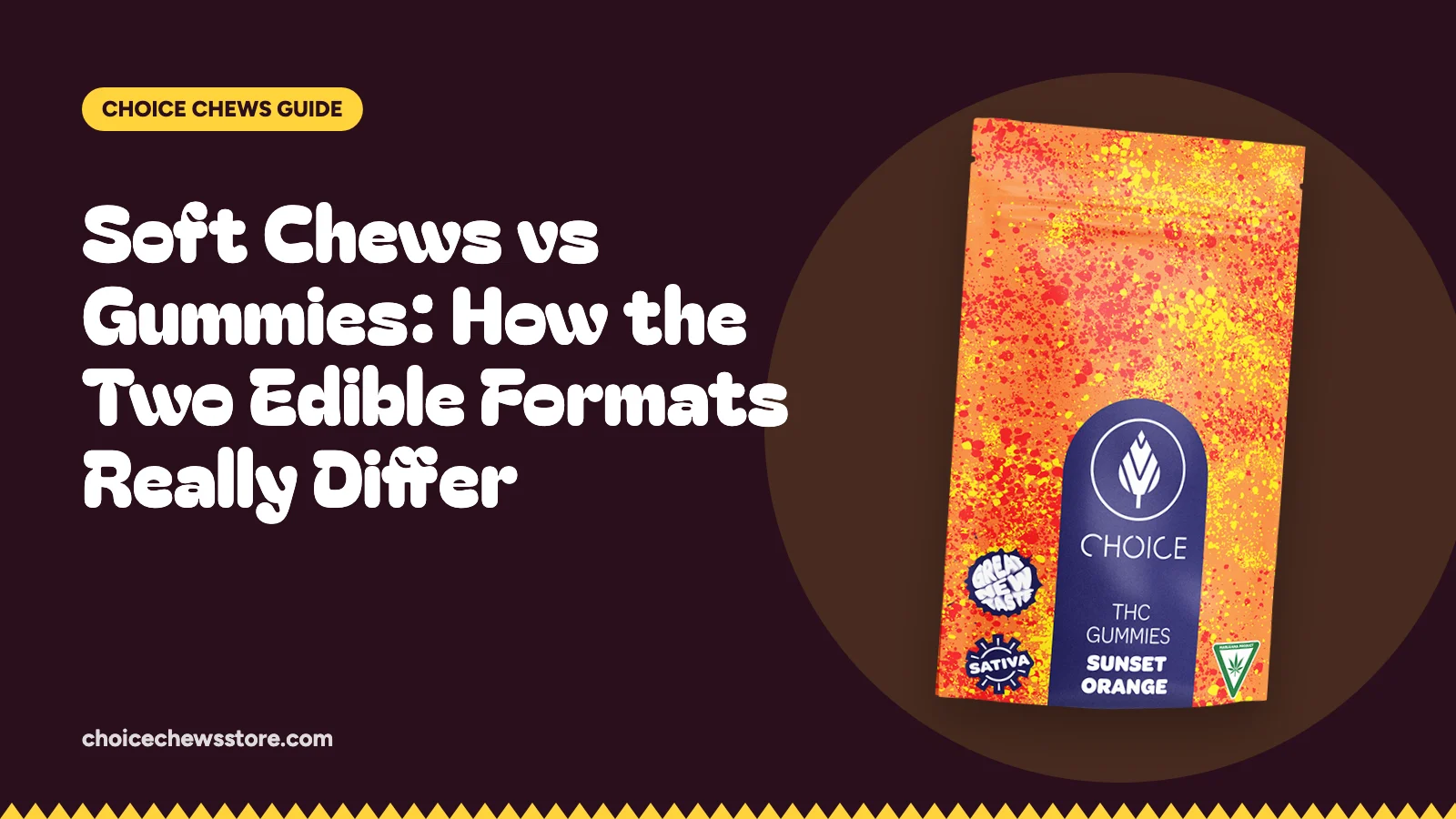
This soft chews vs gummies guide sets the two formats next to each other on the points that matter to a buyer: texture, how easily they cut, how they cope with heat, how to store them and how the dose is shown. Choice Chews are our running example, since the packs say “THC GUMMIES” while the product itself is a soft chew.
Soft chews vs gummies: the short answer
If you only read one paragraph, read this one. A soft chew is dense, smooth and slightly stretchy, akin to a fruit taffy. A gummy is springy and bouncy, the texture of a classic gummy bear. In the soft chews vs gummies matchup, neither one is better; they simply suit different people.
The bigger point in soft chews vs gummies is what stays the same. The THC dose of any piece is set by its label, not by its shape or its chew. A 20mg soft chew and a 20mg gummy contain the same amount on paper, so the label still does all the dosing work.
Why the naming gets muddled
Shops, menus and even packaging use the words loosely. Choice Chews packs carry the words THC GUMMIES, yet anyone who has tried one will tell you the bite is pure soft chew. That overlap is why the soft chews vs gummies question comes up so often.
Who this comparison is for
The comparison here is written for adults 21 and over who are picking an edible format for the first time, or who have tried one and wondered whether the other side of soft chews vs gummies would suit them better. If you already know which texture you love, skip ahead to the table and the storage notes.
What makes a soft chew a soft chew
Soft chews belong to the taffy and fruit chew side of the candy world. The texture is dense and smooth, it gives under gentle pressure, and it softens further as it warms in your mouth. You chew it for a little while rather than bouncing through it.
Candy makers usually get that bite from a cooked sugar base worked until it is pliable, often with some fat for smoothness. The exact recipe varies by product, which is why the ingredient panel matters more than any general description. Choice Chews sit firmly in this taffy style family.
How a soft chew feels on day one and day thirty
A fresh soft chew is pliable. One that has been stored warm can slump, and one stored very cold can firm up. That sensitivity to temperature is one of the clearer dividing lines between the two formats.
Shape follows texture
Soft chews are usually pressed or cut into squares and bars, since a dense dough does not hold intricate molds well. When you lay soft chews vs gummies out on a table, that blocky silhouette is often the quickest way to tell them apart before anyone takes a bite.
What makes a gummy a gummy
Gummies are built around a gelling agent. Gelatin gives the classic bouncy bear, while pectin, a fruit fiber, gives a shorter, cleaner bite that many plant based gummies rely on. The result holds its shape firmly and springs back when you squeeze it.
That structure makes gummies easy to mold into shapes and colors, and it is why so many edible ranges arrive as bears, rings or cubes. It also leaves a gummy feeling a little rubbery to people who prefer a softer candy.
Pectin gummies are often described as juicy with a short, clean bite, while gelatin gummies get called bouncy. In a blind soft chews vs gummies taste test, those two gummy styles can feel as different from each other as either does from a chew.
The gelatin question
Gelatin is an animal product, so anyone with dietary rules around it reads gummy packaging closely. The same habit applies on both sides of soft chews vs gummies, since you cannot tell what is inside from texture alone. Our guide to the Choice Chews ingredients label shows where to look.
Side by side comparison table
Here is the soft chews vs gummies comparison condensed into one table. These are general format traits, so treat them as tendencies rather than fixed rules for every product.
| Trait | Soft chews | Gummies |
|---|---|---|
| Texture | Dense, smooth, taffy like | Springy, bouncy, gel based |
| Chewing time | Longer, softens as it warms | Shorter, breaks apart quickly |
| Cutting | Clean slices with a sharp knife | Can rebound or tear |
| Heat | Softens and can slump | Can sweat or stick together |
| Common shapes | Squares and rectangles | Bears, rings, cubes, drops |
| Where the dose lives | On the label | On the label |
The last row is the one to remember. Format changes the experience in your mouth, but it never changes where you find the dose.
If you are still on the fence after reading the soft chews vs gummies table, focus on the two rows that affect daily life most: cutting and heat. Those are the traits you will notice every time you open the pack.
Texture and mouthfeel in practice
Texture is the real heart of soft chews vs gummies, and it is personal. Some people love the slow, chewy give of a taffy style piece. Others find it sticks to their teeth and would rather have something that breaks apart quickly. Mouthfeel is usually the first thing people mention when they describe soft chews vs gummies to a friend.
A soft chew also tends to carry flavor for longer, because it sits in your mouth while you work through it. Creamy flavors suit that format especially well. A pack like Orange Creamsicle 200mg leans on that slow, rounded release, the way the frozen treat it is named after does.
Dental work and sticky candy
If you have braces, crowns or fillings that do not like sticky candy, think about that before you buy. A small piece cut from a chew is easier on dental work than a whole one, and some people simply prefer a gel gummy for this reason.
Cutting and portioning each format
This is where the chew quietly wins the soft chews vs gummies contest for many buyers. A dense chew takes a knife cleanly, so you can split a 20mg piece into two 10mg portions or four 5mg slivers without much mess. Chilling the chew for a few minutes makes the cut even neater.
Gummies are harder to portion. The springy gel resists the blade, and small pieces can tear unevenly. When people weigh soft chews vs gummies purely on portion control, the chew usually comes out ahead.
Our step by step guide to cutting Choice Chews covers tools, chilling and keeping cut pieces fresh. For the figures inside each piece, the THC per gummy guide breaks the packs down.
Portioning for newer buyers
Newer buyers gain the most from easy cutting. With a soft chew, a small slice is simple to cut and simple to repeat, which keeps early sessions predictable. That handy edge comes up again and again when people weigh soft chews vs gummies for a careful start, and our first time edibles guide covers that first session in full.

Does the format change how fast it kicks in?
This is the soft chews vs gummies myth we hear most. Both are swallowed and processed through digestion, so both follow the slow edible pattern described in general resources like the cannabis edible overview on Wikipedia. Neither format is designed to act like a fast acting product.
Some people insist one feels quicker than the other. Food in your stomach, your own body and the dose itself all play a much bigger role than texture. Plan for a slow start either way, and wait a full two hours before deciding to take more.
Our guide on how long Choice Chews take to kick in goes into timing in more detail.
Why the myth persists
Part of the reason is that people often switch format and dose at the same time. If your first soft chew was a bigger dose than your old gummy, it may feel stronger and sooner, and the texture gets the credit. A fair soft chews vs gummies test keeps the dose identical and changes only the format.
Flavor carry and variety
Gummies have a head start on color and shape, which is why so many brands sell them in rainbow mixes. Soft chews win on depth. A dense chew can hold layered flavors such as fruit plus cream, or fruit plus spice, without them fading quickly.
Choice Chews lean on that strength. Blends like Pineapple Mango Coconut, Strawnana Smoothie or Mango Chili Lime would be hard to pull off with the same richness in a light gel. Flavor is often what settles soft chews vs gummies for people who care more about taste than texture. Taste is subjective, though, so treat any flavor verdict, ours included, as a starting point.
If you want to see the range, the Choice Chews flavors page lists every flavor we carry with its strain label.
Heat, travel and storage
When it comes to soft chews vs gummies in the heat, both formats suffer, but they fail in different ways. A warm soft chew softens and can lose its shape inside the wrapper. A warm gummy tends to sweat and fuse to its neighbors. Neither is pleasant, and neither belongs in a hot car or a sunny window.
Cool, dry and dark is the rule for both. Soft chews can firm up in a fridge, so let one sit at room temperature for a few minutes before eating if you store them cold. Above all, keep any edible sealed and well out of reach of children and pets.
Travel tips for both formats
On the road, the soft chews vs gummies difference shows up quickly. Chews that soften in a warm bag usually firm up again once cooled, while gummies that have fused can be hard to separate cleanly. A small insulated pouch helps either format. Check local laws before traveling with any cannabis product, since rules differ by state.
For storage detail tailored to these packs, read how to store Choice Chews.
Reading the label is the same for both
Whichever side of soft chews vs gummies you land on, your checklist at the label does not change. Look for total THC in the pack, THC per piece, the strain label if there is one, the ingredient panel and any allergen statement.
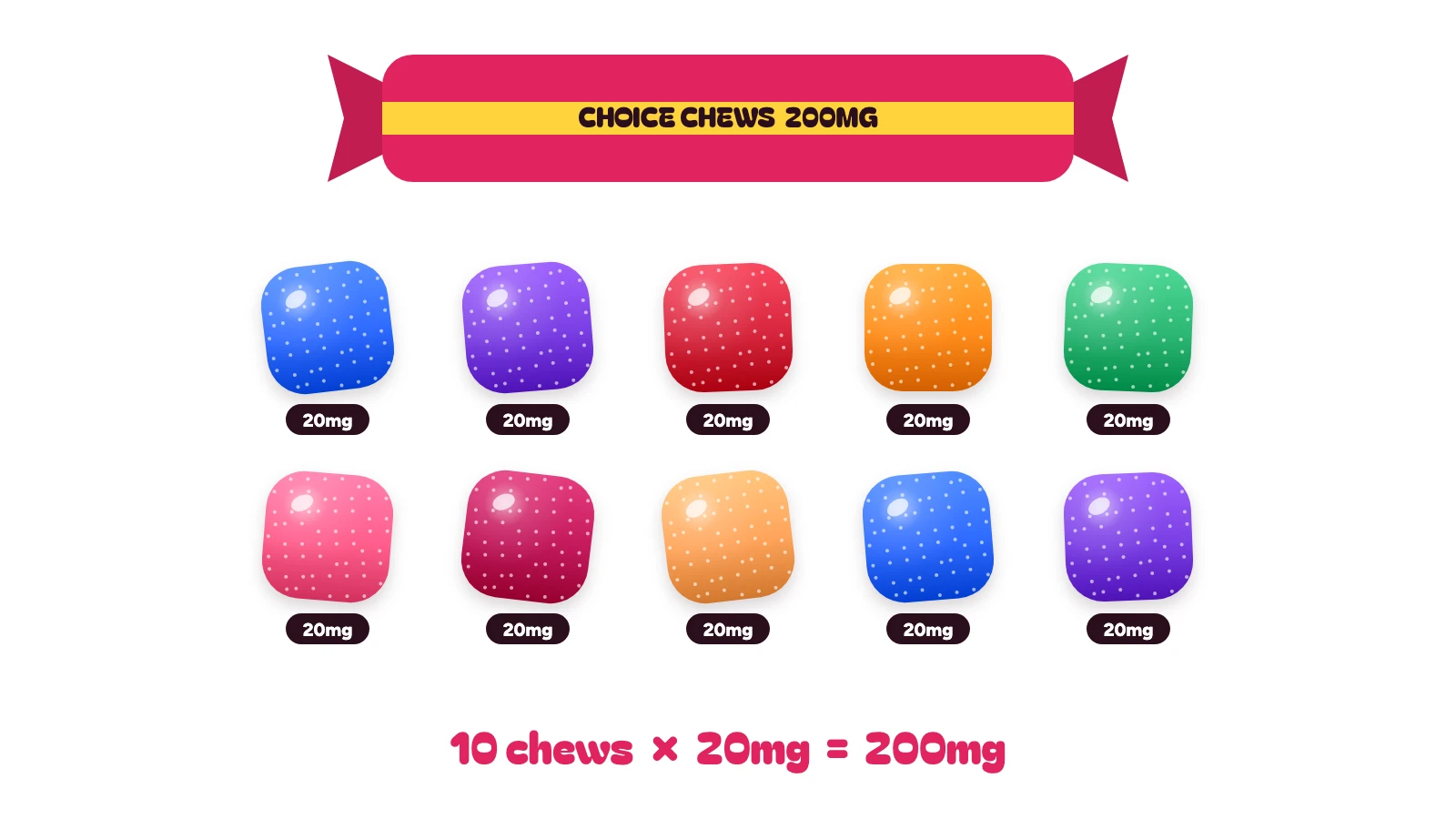
For Choice Chews, the 200mg pack holds ten chews at 20mg each. The 100mg pack has its per piece dose printed on the label, so read that pack directly rather than assuming. If a figure on a pack does not add up, that is a reason to pause, and our real or fake guide explains what to look for.
One more habit worth keeping: note the strain label, INDICA, SATIVA or HYBRID, on the face of the box. It plays no part in soft chews vs gummies, but it is part of how many buyers pick between packs, and the indica vs sativa guide explains how people use it.
Where Choice Chews sit in the debate
Choice Chews are a useful soft chews vs gummies case study because they straddle both words. The packs say gummies, menus say chews, and the product itself is firmly on the chew side. If you have only ever had gel gummies, prepare for something denser and more taffy like. In soft chews vs gummies terms, Choice Chews are a chew through and through, whatever the box calls them.
For a newer buyer, that density is handy. It makes splitting a piece easy, and the gentler 100mg packs such as Strawberry Lemonade 100mg leave ample room to start small. For an experienced buyer, the 200mg packs offer a full 20mg chew that cuts cleanly when you want less.
Cost and value in both formats
Price is one more area where format matters less than you might think. Value comes down to how many milligrams of THC you get per dollar, not whether those milligrams arrive in a chew or a gel. Comparing soft chews vs gummies on cost only makes sense once you set each price against the total THC on each label.
Choice Chews packs start from $14.99 here, and the Choice Chews price guide walks through the per milligram arithmetic. A larger pack usually brings that figure down, which is one reason experienced buyers lean toward 200mg packs.
Newer buyers often prefer a 100mg pack anyway. Finishing a smaller pack while it is still fresh matters more to them than shaving a few cents off each milligram, and the lower total leaves more room to experiment with small portions.
Choosing between soft chews vs gummies for yourself
Ask yourself three quick questions. Do you like a slow, dense chew or a quick, bouncy one? Do you plan to cut pieces into smaller portions? Do you have dental work that dislikes sticky candy?
If you like a dense bite and want easy portioning, soft chews are probably your format. If you prefer bounce and do not plan to cut anything, gummies may suit you better. There is no wrong answer to soft chews vs gummies as long as you read the label and start low.
Try both before you settle
If you cannot decide, there is no harm in trying a small portion of each format on separate days. Keep the dose the same, jot down how the texture and taste felt, and let your own notes settle soft chews vs gummies for you rather than someone else’s preference.
Ready to try the chew side? The Choice Chews shop carries every flavor we sell, sealed in original retail packaging, for adults 21 and over in the USA.
Soft Chews vs Gummies: How the Two Edible Formats Really Differ: quick answers
Is there a dose difference in soft chews vs gummies?
Not by format. The THC in any piece is whatever the label says, whether it is a dense chew or a gel gummy. A 20mg chew and a 20mg gummy are the same dose on paper. Texture changes the eating experience, not the amount.
Are Choice Chews soft chews or gummies?
They are soft chews. The packaging uses the words THC GUMMIES, but the bite is dense and taffy like rather than springy. That is why people often search for both terms when they are looking for the same product.
Comparing soft chews vs gummies, which is easier to cut into smaller doses?
Soft chews usually cut more cleanly. A sharp knife slices through a dense chew without tearing, especially if the chew is chilled for a few minutes first. Gel gummies tend to rebound against the blade and can split unevenly.
Do soft chews kick in faster than gummies?
There is no reliable difference to plan around. Both are eaten and processed through digestion, so both follow a slow edible timeline. Food, your body and the dose matter much more than texture. Wait a full two hours before taking more.
Which handles warm weather better, soft chews vs gummies?
Neither handles heat well. Soft chews soften and slump, while gummies sweat and stick together. Keep both in a cool, dry, dark place, sealed and out of reach of children and pets, and never leave them in a hot car.